
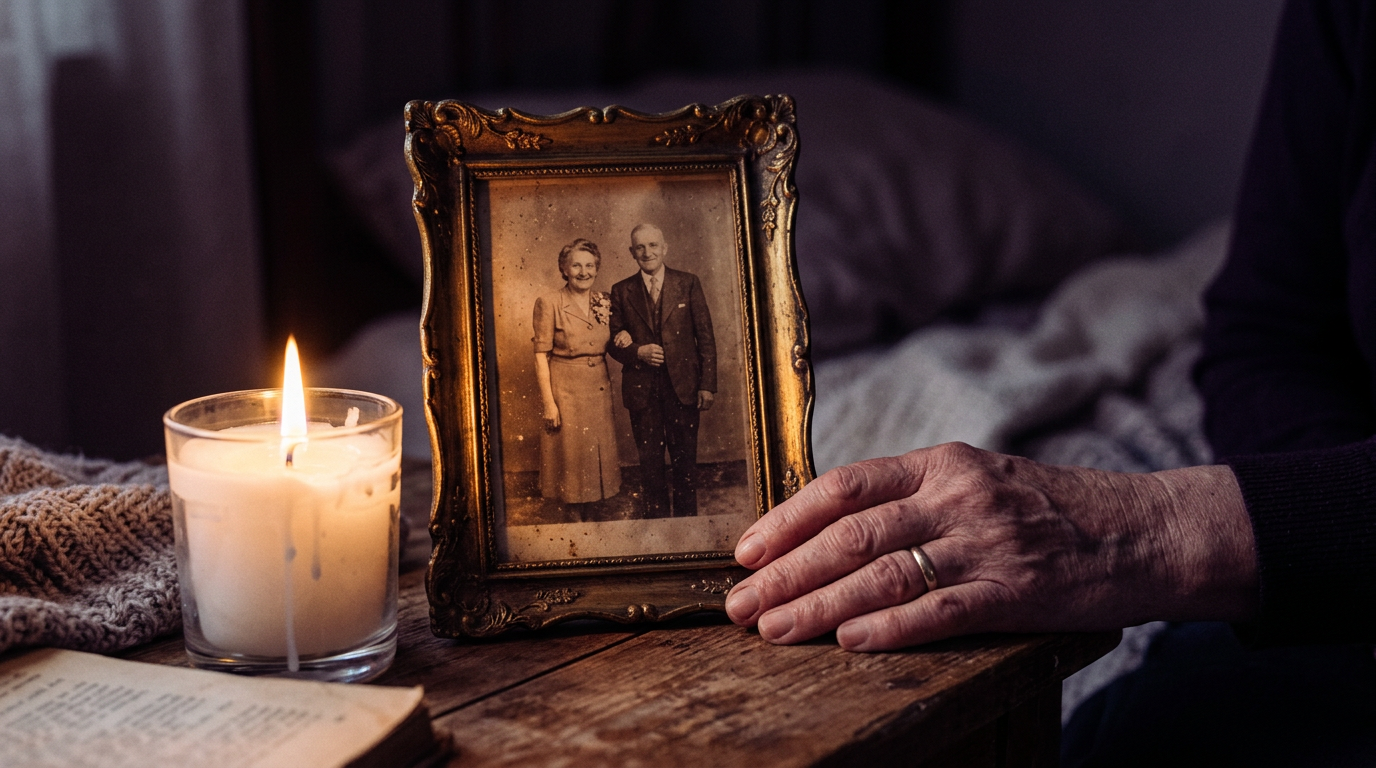
The activity is rarely what you think. The person in the middle of it always is. There are basically two ways our culture talks about the paranormal. One is entertainment — jump scares, night-vision cameras, a TV crew shrieking at a creaky floorboard. The other is pure fear — something dark and evil coming for you in the dark. Both make for good television. And both miss almost everything true about the work. Because when you actually do this — when you walk into real homes, sit at real kitchen tables, and help real families — you learn very quickly that the paranormal is, first and last and underneath everything, a human story. Not the way the movies mean it. In a truer, quieter, more important way. Let me tell you what I mean.
It's almost never who you think it is
Start with the biggest myth, the one television has hammered into everyone: that every bump in the night is a departed loved one. Grandma at the foot of the bed. A message from beyond. It's just not what the evidence bears out. I want to be careful here and honest — I haven't sat down and crunched the numbers from my own casework against everyone else's, so I'll speak from field experience rather than hand you a statistic. But what most of us who do this work seriously tend to find is that only about a quarter of genuine activity — maybe up to a third in residential cases — is actually human, or ever was human. The clear majority is something else entirely: energy that isn't and never was a person; residual hauntings — what's often called Stone Tape Theory, the idea that an intense moment gets imprinted onto a place and simply replays, like a recording, with no awareness or intent behind it at all; and — a huge share — things that aren't paranormal in the ghost sense whatsoever. That residual category is worth pausing on, because it is the exact opposite of what people fear. A recording can't target you. It can't follow you, it can't think, and it cannot intend you any harm — it just runs, the same loop, indifferent to whoever's watching. It poses zero threat to anyone. Being able to tell a terrified family "what you're experiencing is real, and it is also completely harmless" is often the single most reassuring thing I get to say in this whole line of work. And that last category — the things that aren't paranormal at all — is the one nobody wants to talk about, and it's the one that matters most for the people living through it.
The house might be making them feel that way — literally
A great deal of what gets reported as a "haunting" turns out to be the environment acting on the human body. Not imagination. Not lying. Real, physical causes producing real, frightening sensations. Strong electromagnetic fields are a classic culprit. There's a growing body of research linking EMF exposure to disrupted sleep, anxiety, low mood, and a general sense of unease — and in the field we run into homes where the EMF, or other environmental factors like elevated
background radiation or poor air quality, are quietly working on the people inside them. Neuroscientist Michael Persinger famously found that weak magnetic stimulation could
make a striking number of subjects feel "an unexplained presence" in the room — though, in fairness, later attempts to replicate that pinned much of the effect on suggestibility, and the science is still genuinely debated. Infrasound — sound too low for us to consciously hear, around 19 Hz — is even better documented. The engineer Vic Tandy tracked a "ghost" in his lab to a fan vibrating at exactly that frequency; it was producing dread, cold shivers, and shapes at the edge of his vision by literally vibrating his eyeballs. And then there are the plainly medical causes that mimic a haunting almost perfectly: carbon monoxide from a faulty furnace, which can cause hallucinations, headaches, and weakness; mold; sleep paralysis, with its immobility and vivid, terrifying visions. I'm also weighing the subtler energetic factors the entire time — the frequencies and vibrations moving through a space and how a particular body responds to them, since some people are far more sensitive to that input than others — as well as any energy work or spiritual practice that has taken place in the home, and what it may have stirred or left behind. All of it is on the table in a residential case, because all of it can shape what a person is actually experiencing. None of that makes the family wrong for calling. It makes them right to want answers — and it means the first responsible act in this work is never a séance. It's ruling things out.
The whole person, then the whole situation
So here's how we actually work a residential case — and I say we on purpose, because I do not do this alone. I'm a co-founder of Soul Fire Paranormal, and every investigation is a team effort, from the first phone call to the last follow-up. The whole approach I'm about to walk you through has been built and fine-tuned by us together, each bringing a different strength to a different part of it. I bring one particular lens — the same gifts I've carried since I was a child — but I'm one member of a team, not a lone ghost hunter with a flashlight. We start with the living person. The whole person. Long before anyone thinks about anything unseen, we're doing extensive interviews — personal history, family history, the property's history, health, stress, relationships, sleep, what's changed lately, what they believe and what they've practiced (which, understandably, people don't always volunteer). We gather data of many kinds, environmental and human both. And then we do the unglamorous, essential work: we sort the sources. Because a haunting is almost never one clean thing. It's usually a stack — a little EMF, a lot of grief, a real loss, an old fear, a genuine unexplained something, all tangled together — and each source has to be identified and addressed on its own terms. Some of it gets solved by an electrician or a doctor. Some of it doesn't. And here's a source most people never think to consider: sometimes it's a person in the home. If someone under that roof is gifted — sensitive, intuitive, what those of us in the community would call a beacon — they can genuinely draw and amplify activity, and they'll almost always perceive far more of it than anyone else in the household. This isn't a fringe hunch, either. There's real research behind it: studies consistently find that people who are highly sensitive, and especially those high in what psychologists call transliminality — a thinness of the boundary between the conscious and unconscious mind — report significantly more anomalous experiences than everyone else. And here's what ties it straight back to what I wrote last week: it holds true whether or not the person has ever accepted their gifts. Someone who has spent a lifetime in denial of their abilities is often the very reason a household is experiencing so much — a beacon lit with no off switch, pulling in more than they can filter, and getting called "too much" for it, when the truth is they were simply built more open than the people around them. Recognizing that isn't just good investigating. Sometimes it's the entire answer. We
investigate the whole situation, not just the house — because the house is only ever part of it. The people are the rest, and the people are the point.
The human underneath the haunting
Here's the thing that ties it all together, and it's why I can call this a human story with a straight face even though the activity itself is only sometimes human: whatever is actually happening in that home, there is almost always a person in the middle of it carrying something heavy. Grief they haven't finished. A loss that cracked the world open. Fear that's been running them for months. A life that came unglued, and a question they can't put down. The activity might be twenty-five percent human. The experience is one hundred percent human, every single time. The fear is real. The exhaustion is real. The person is real. And that's the part I will not treat as background noise, because it's the actual heart of the whole thing. Every door I knock on is a person first. And it brushes, always, against the biggest questions there are: What happens when we die? Is there more than this? Are we alone? Is something out there — and does it know my name? Those aren't ghost-hunting questions. They're the oldest human and spiritual questions we have, and for a lot of people, a frightening night in their own home is the first time they've ever had to face them for real. That's the God part of "ghosts, grief, and God" — not a doctrine, but the ache for meaning that this work uncovers in almost everyone it touches.
The part everyone skips
And then there's the piece that shaped how we built Soul Fire's entire approach, because I'd watched the field ignore it again and again: the aftercare. Most investigations end when the gear gets packed up. The team leaves, maybe with a dramatic conclusion, and the family is left standing in the driveway — still scared, still grieving, still living in that same house tonight and every night after. The support, the resources, the honest followthrough, the are-you-actually-going-to-be-okay — almost always completely ignored. We refuse to skip it. Because if the person was the point the whole time, then caring for them after is not a courtesy tacked onto the end of the work. It is the work. Helping someone reset the balance in their home, pointing them to real resources for the grief or the fear or the health issue we uncovered, making sure they're not left alone with whatever we found — that's the part that actually changes a life.
What I really believe in
So when people ask me whether I believe in ghosts, I've learned to give them the truer answer. I believe in people. I believe that behind almost every call is a human being carrying something they were never meant to carry alone, in a house that may or may not be doing exactly what they think it's doing — and that they deserve someone who will take all of it seriously: the science and the spirit, the faulty wiring and the genuine unknown, the fear and the grief and the question underneath. The paranormal, done with any real care, was never actually about the dead. It's about the living. It always was. And the whole job — the entire, sacred point of it — is to make sure not one of them is left alone with it. — Jen
A note on the science: the percentages above are my field experience, not a formal study. The environmental explanations are real and worth reading up on. On infrasound and the "ghost frequency," see Vic Tandy's work and the Smithsonian's "Five Scientific Explanations for Spooky Sensations." On electromagnetic fields and the brain, there's a real (and still-debated) research literature — Michael Persinger's "sensed presence"
experiments are the famous example, though later replication attempts (the "Haunt" project by French and colleagues) credited much of the effect to suggestibility, so hold it loosely. And carbon monoxide poisoning is a documented mimic of hauntings. On highly sensitive people reporting more anomalous experiences, look into the research on "transliminality" (Michael Thalbourne) and on sensory processing sensitivity and boundary- thinness as predictors of anomalous experience. The point isn't that it's "all in your head" — it's that a good investigator rules the physical causes out first, precisely because the people deserve the truth.