
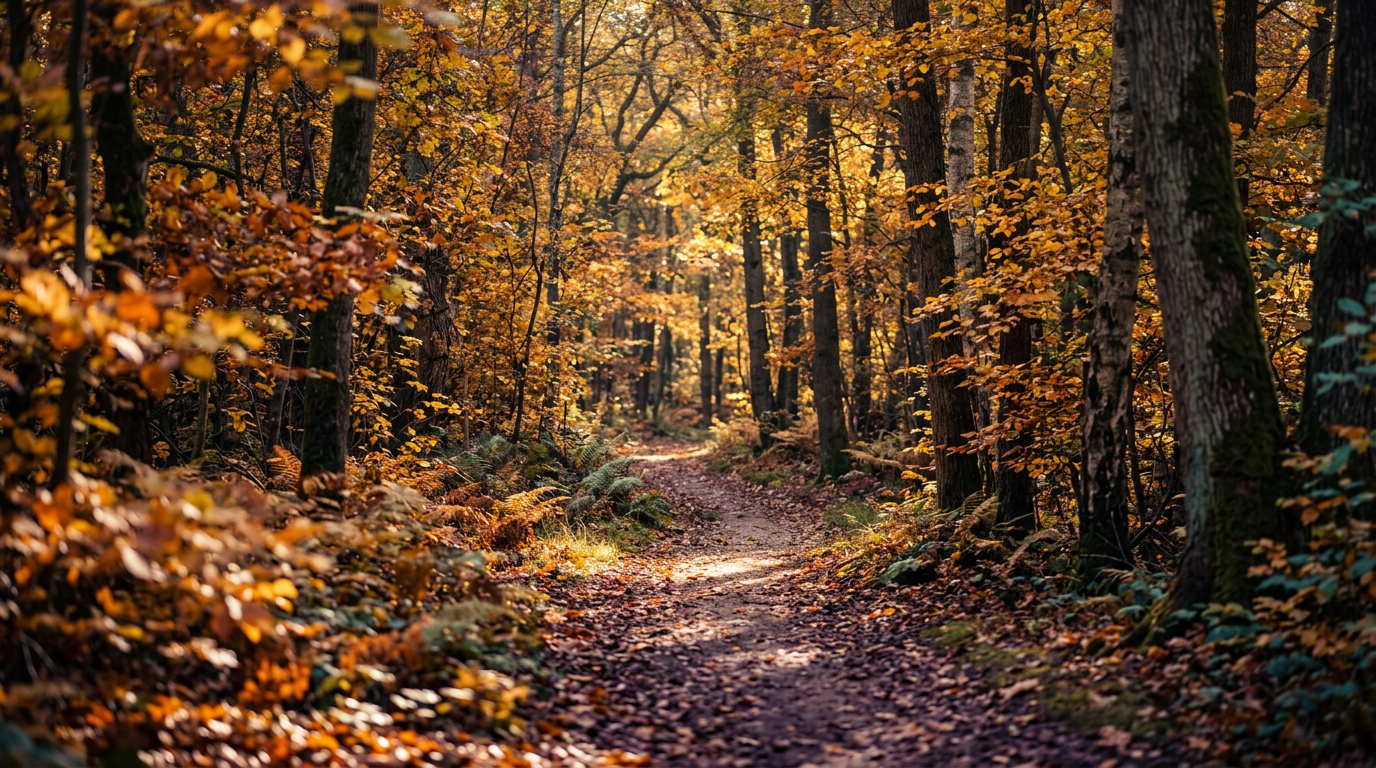
When "stuck" is really "not now" Look outside right now and everything is mid-transition. The light is changing, the leaves are turning loose, the whole world is quietly letting go of one season and not yet arrived in the next. Fall is change made visible — which makes it a fitting time to talk about the place so many of us are secretly living: the in-between. The place that feels an awful lot like being stuck. Maybe a chapter ended — a job, a relationship, a role, a version of your faith, a season of raising kids that's suddenly over. Maybe nothing dramatic ended at all; you just woke up one day and the life that used to fit doesn't anymore, and you can't say exactly when that happened. Either way, you're standing in the gap: the old thing is gone or going, and the new thing hasn't shown up yet. And it feels like failure. Like you're doing life wrong. Like everyone else got the map and you're just... stuck. I want to offer you a different way to see it — one that changed how I move through every transition in my life.
The in-between isn't failure. It's passage. Here's what's actually happening when you feel stuck in a transition: an old identity has ended, and the new one hasn't formed yet. That's it. You're not broken and you're not behind. You're in the gap between who you were and who you're becoming — and that gap is real, and it's uncomfortable, and it's supposed to be there. The mistake we all make is treating the in-between as a problem to fix instead of a passage to move through. But every real change has one — a stretch where the important work is happening underground, out of sight, where it doesn't look like anything at all. The pause isn't the opposite of progress. Very often it is the progress, just the part you can't see yet. So the stuck feeling isn't evidence that something's wrong with you. It's evidence that you're in a passage. And passages, by their nature, are meant to be passed through — not fixed, not forced, and not fled.
What a burned forest taught me
I learned this before I had any words for it, on a family trip through Yellowstone when I was a kid, not long after the great fires had torn through and taken so much of the old- growth forest with them. I'll be honest: the devastation was real. Miles of blackened trunks, a landscape that looked like grief itself. You couldn't look away from it, and you couldn't pretend it was anything other than a loss. But even standing in the middle of all that char, I understood something I wouldn't have the word for until years later. The word is succession — the way an ecosystem moves through stages to remake itself after a disturbance — and Yellowstone is one of the most beautiful teachers of it on earth. Because that forest wasn't only dying. It was being remade, and the fire was doing the remaking. Later, when I trained as a Master Naturalist and actually studied these systems — their complexity, their staggering interdependence, their built-in need for disturbance in order to stay alive — I finally understood what I'd only felt as a kid. That fire wasn't the enemy of the forest. It was part of how the forest works. The lodgepole pines that make up most of Yellowstone keep their seeds locked inside cones sealed with resin that only fire's
heat can melt open — the forest literally cannot reseed itself without burning first. The flames that looked like pure destruction were, in the very same moment, cracking open the future. And the ash left behind wasn't waste — it was fertilizer. As the fire burned the old growth back down into the soil, it released a flush of the very nutrients new life feeds on: a pulse of nitrogen the seedlings could actually use, along with phosphorus and potassium and minerals, laid down like a meal on the forest floor. Add the newly opened canopy letting light pour back in, and the new growth suddenly had everything it needed to begin — light, bare ground, and the ash of what came before feeding it from below. Grasses and wildflowers came back within a single season. It was brutal. And it was, genuinely, beautiful. Both at once, in the same ground, at the same time. So it is in a life. And here's the part that matters for you, standing in your own scorched clearing and wondering why you can't seem to move: the stuck is not the fire, and it is not the end. The stuck is the stage that comes after the loss — the quiet, unglamorous, invisible-looking stretch where the nutrients are returning to the soil and the new growth is just barely beginning. It doesn't look like progress. It looks like a burned, empty field. But it is the most fertile ground there is.
Stuck isn't stuck. It's "not now." Here's the reframe I lean on hardest, and I mean it as literally as I can say it: stuck is rarely a wall. It's a hold. When you feel truly stuck, the path forward usually isn't blocked. It's just not clear yet — because it isn't time yet, or because something isn't finished. "Stuck" almost always translates to not now. And "not now" is a world away from "never." One is a locked door. The other is a door that simply hasn't opened yet, and the difference between despair and patience lives entirely in knowing which one you're actually looking at. So the real question in a transition isn't "how do I force my way forward?" It's "why is this a not-yet — and what is it waiting on?"
The reason for the season
There's an old idea — one I lean on so much it made its way into my book — that the people, the hardships, and the chapters of our lives come to us for a reason, a season, or a lifetime. Some things are meant to stay forever. But so many are meant for a season only — and every season carries a reason. A lesson. A purpose. Something it came into your life to do in you. And here's what I've come to believe about being stuck: a lot of the time, we're held in the in-between because a season's reason isn't complete. There's a lesson we kept skimming past. A purpose that chapter came to serve that we never let it finish. A piece of the work — grief we wouldn't feel, a truth we wouldn't say, a forgiveness we wouldn't offer, a version of ourselves we wouldn't lay down — that we left undone and walked away from too soon. And we can't fully step into the next season while the last one is still holding an unfinished thread. The stuckness, then, isn't a punishment. It's a hold — a gentle, insistent nudge to turn around and complete what was left undone, so the path in front of you can finally come clear.
Go back and finish what's undone
So that's the work, and it's tender work, not a to-do list: go back — gently — for the thing you left unfinished. Ask the honest questions. What did that season come to teach me that I keep dodging? What was it trying to do in me that isn't done? What am I refusing to feel, to learn, to forgive, to say, or to set down — and could I finally do it now? You'll usually find the answer waiting closer to the surface than you'd like. We almost always know the thing we skipped; we just didn't want to face it. You don't have to relive the whole past — that's rumination, and it keeps you more stuck, not less. You're looking for the one unfinished
thread, and you're going back to tie it off. And this is where everything we've been practicing comes in. Sort the load — what here is genuinely mine to complete, and what was never mine to carry into the next season at all? Examine the belief that's keeping you frozen — is it even yours? Breathe at the jolt when the old grief flares, and name it instead of drowning in it, so you can tell the true signal from the noise. Lay new rail — because completing the lesson usually means practicing a new way of being, one small rep at a time. The whole toolkit was quietly building to a moment exactly like this. And so often, the instant you complete the undone thing — feel the feeling, say the truth, forgive the person, release the old self — the path forward that seemed so hopelessly blocked just... appears. Not because the universe rewarded you, but because the thing blocking the view was the unfinished thing all along.
Sometimes it's only the timing
One honest caveat, because I don't ever want to hand you a formula that turns into self- blame: sometimes there's no unfinished lesson at all. Sometimes the "not now" is purely timing — the season simply hasn't turned yet, and no amount of finishing on your part will rush it. When that's the case, the work isn't to complete something. It's to wait well — to be fully in the season you're in instead of clawing at the door of the next one, to trust that the timing isn't broken just because it isn't yours to set. Learning to tell those two apart — "there's something to finish" versus "there's a time to wait for" — is its own kind of wisdom, and you build it the same way you build all of it: quietly, with practice, and a lot of grace for yourself in the meantime.
You're not stuck. You're in-between. So the next time that heavy, going-nowhere feeling settles in, try trading the word. You're not stuck. You're in-between — which is not the same as lost, and never the same as done. Something is either asking to be finished or asking to be waited for, and both of those are not now, never never. Go back for what you left undone. Wait well where you must. And trust the thing that's carried me through every transition I've ever survived: the path clears — often the very moment you stop forcing it and turn around to finish what you walked away from.
This week: name your season
If you want one concrete thing to do: name the season you're leaving. Say it plainly — "I'm leaving the season of ______." Then ask it two questions and write down whatever comes: What did this season come to teach me? and What still feels unfinished about it? Don't force an answer; just let the honest one surface. Then pick the single smallest step toward finishing that one unfinished thing — a conversation, a good cry, a boundary, a prayer, a thing finally said out loud — and take it this week. You might be amazed how much of the road ahead comes clear the moment you turn around and close the loop behind you. — Jen On the fire ecology: Yellowstone's lodgepole pines really do carry serotinous cones — sealed with resin that only fire's heat can melt open — and the ash left behind releases a flush of plant-available nutrients (a pulse of nitrogen, plus phosphorus and potassium) that, along with the newly opened canopy, feeds the regrowth. (Fire also volatilizes some nitrogen into the air — it takes and gives at once.) If you'd like to read more, the National Park Service's "Ecological Consequences of Fire" at nps.gov is a lovely overview.